- The Productive Disruptive
- Posts
- Whose Mic Is This Anyway?
Whose Mic Is This Anyway?
Every Tuesday, The Productive Disruptive delivers storytelling science, message makeovers, cultural commentary, and a little rebellious hope for anyone still stubborn enough to believe communication can change the world.

Dorian Johnson
August 19, 2025
Did a wise PHriend forward this to you? [Subscribe here.]
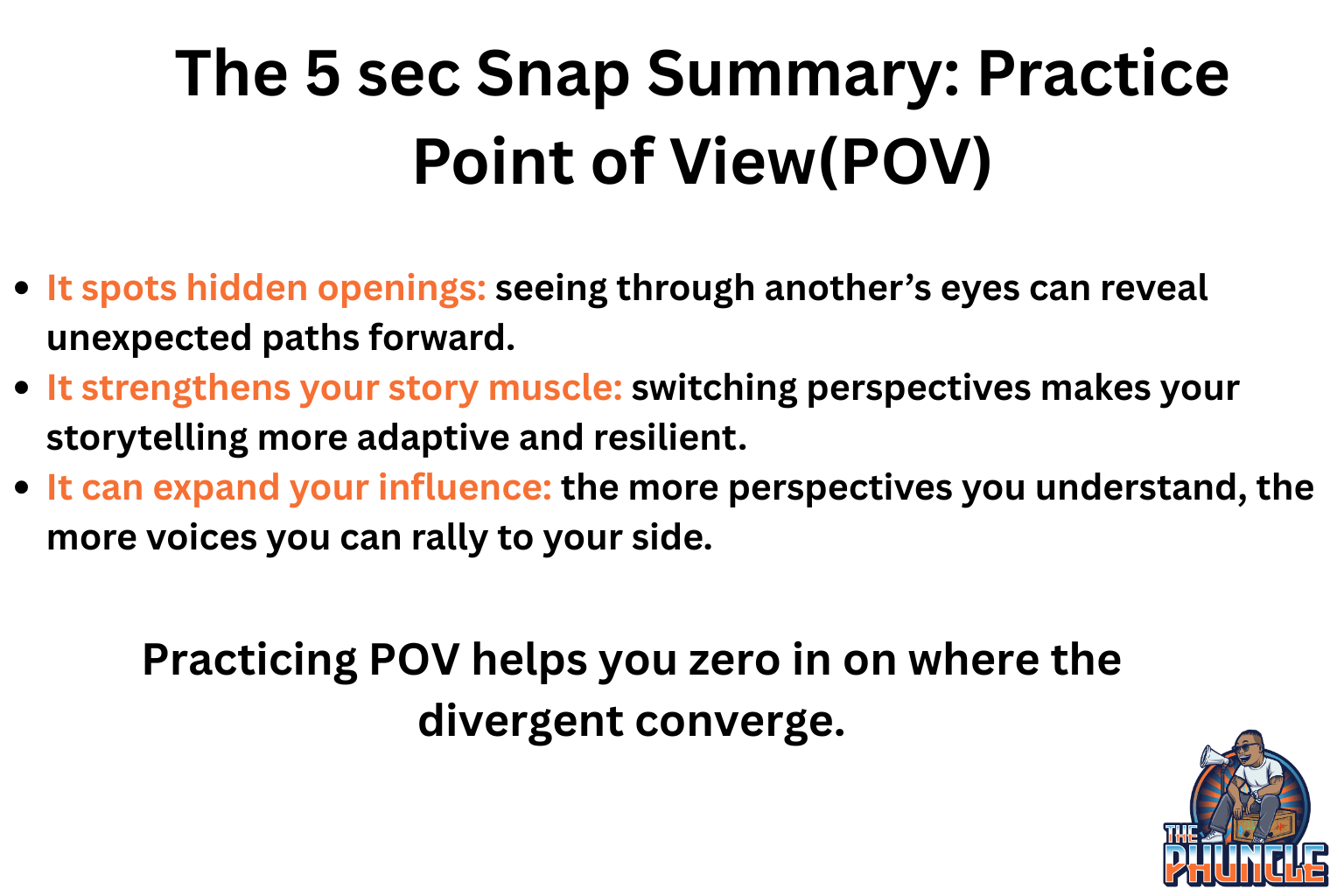
There’s no such thing as a neutral story.
Every story carries a point of view(POV).
The only question is, whose?
The same reality can shift from love to hate, from obstacle to opportunity, or from pride to problem just by changing who’s holding the mic.
And if we’re not playing with perspective, we’re missing an opportunity to build storytelling muscle.
POV accomplishes a couple things.
It sharpens stakes.
It reveals contrast.
It turns “one story” into multiple.
Let’s share an example.
Picture an empty field:

Now let’s add some characters.
Each of these characters will have a different desire for the same empty field.
What could go wrong?
An environmentalist might see renewal.
A developer, opportunity.
A neighbor could see disruption.
Each of these isn’t just an opinion; it’s a story.
And even though they differ, they all see value in the lot.
Can there be a win-win-win? Maybe.
But not without perspective-taking and actually practicing seeing from another’s POV.
🧠 Story Science Side Note: Psychologists call this theory of mind—our ability to imagine what someone else thinks, feels, or believes.
Every time you tell a story through a different POV, you’re exercising that muscle.
POV is like a camera lens.
Tilt it sideways, zoom it in, pull it back, and suddenly, the same scene looks completely different.
The scene didn’t change. Your angle did.
Here’s the tough truth: POV work is not easy. Especially in public health and around social issues where the stakes run high, where lives, policies, and communities are on the line.
It’s not about pretending perspectives are equal. It’s about understanding the landscape of stories—so you can navigate it, respond to it, and sometimes challenge it head-on.
So next time you read a headline, hear a debate, or step into a room divided—
ask yourself: Whose story am I hearing?
And maybe more importantly: Whose story am I not?
Because the power of POV isn’t just noticing differences.
It’s learning to balance them without losing the story you need to tell.
📝 Message Makeover: The phrase “stakeholder management” makes it sound like people are problems to control. I like “perspective mapping”.
Think of each POV as a landmark on the landscape of your story.
Some are mountains (immovable).
Some are rivers (they flow but create boundaries).
Some are bridges (they connect).
Mapping these perspectives doesn’t guarantee smooth travel, but it keeps you from getting lost.
🛠️ The PHacilitator’s Corner:
Try this: Think of a topic you care about.
Tell it from two POVs:
One person loves it.
One person hates it.
Notice how quickly the stakes sharpen. Notice how the contrast makes the story come alive.
Catch you later!