- The Productive Disruptive
- Posts
- Trust, I put this question to you
Trust, I put this question to you
Every Tuesday, The Productive Disruptive delivers storytelling science, message makeovers, cultural commentary, and a little rebellious hope for anyone still stubborn enough to believe communication can change the world.

Dorian Johnson
August 05, 2025
Did a wise PHriend forward this to you? [Subscribe here.]
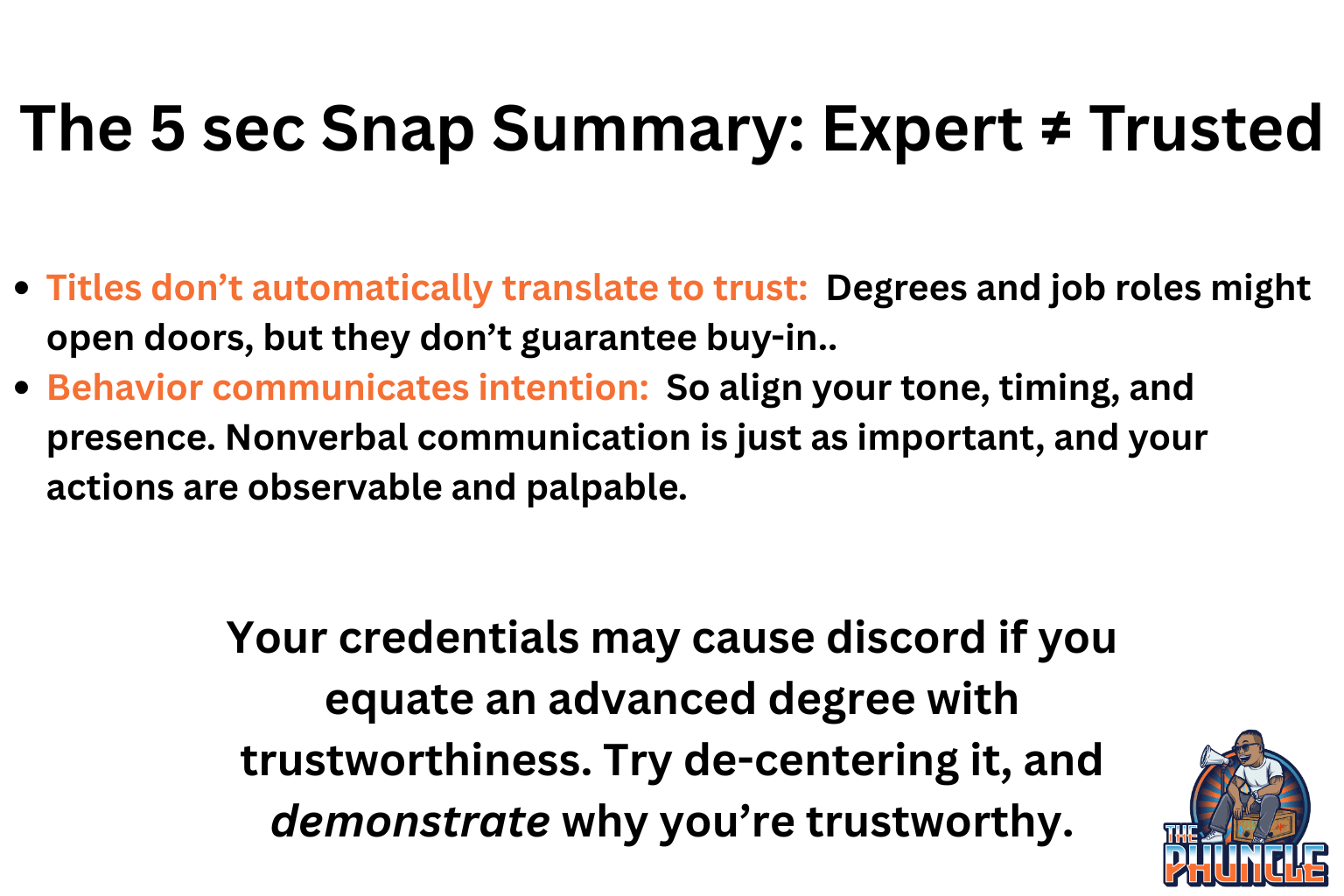
There’s a quiet assumption that’s often a problem…
“Because I know what I’m talking about, people should trust me.”
Take car mechanics.
They’ve got the training.
They’ve got the tools.
They’ve got the grease-stained jumpsuit vibes that say “I do this thaaang.”
But let’s be real…
Do you automatically trust every mechanic off rip?

I’m willing to bet, no.
And you know why?
Because some mechanics run game on people.
What ways do you know of where mechanics might take advantage of customers?
Maybe they start naming parts you’ve never heard of.
Or talk fast in a way that’s hard to follow.
Next thing you know, what was to be a tire rotation and oil change…
Is now fixing to be some elaborate, four-figure job.
It’s not that they aren’t qualified.
It’s that you can’t tell if they’re trying to genuinely help you or hustle you.
And unless you’re in that world, you likely can’t verify the difference.
Oof.
That’s the trust gap.
And let me tell you, it ain’t limited to the garage.
It lives in clinics.
In classrooms.
In community forums.
In public health.
Because when we show up with our credentials but no connection…
when we talk over people instead of with them,
We become the public health version of that mechanic.
ick.
So here’s the question that matters:
How does a mechanic earn your trust?
Reflect on that.
Degrees, credentials, years of experience?
They might earn you a seat at the table.
But they don’t automatically earn you someone’s trust.
That comes from how you show up once you’re already in the room.
And trust is a powerful storytelling tool.
Because when people don’t trust the messenger, it doesn’t matter how strong the message is.
They’ll shut down.
They’ll tune out.
They’ll nod politely while planning to ignore you the second you leave.
Conversely, a trusted messenger with a weak message can have a stronger impact.
Trust is the gateway to action.
And it’s shaped by how you move, not just what you know.
So ask yourself:
Do you leave room for questions, or rush to finish your point?
Do you check in with what people already know before launching into your message?
Do you assume the right to be heard, or earn it through presence and respect?
Because trust isn’t built in your bio
(though it is important. Please don’t misunderstand that)
It’s built in the moments up to and between slides.
The pause before you answer.
The tone when someone pushes back.
The choice to invite understanding, not demand compliance.
And here’s where it gets interesting...
Sometimes, the urge to be seen as “the expert” doesn’t come from the audience.
It comes from you.
🧠 Story Science Side Note: The Looking Glass Self, a concept by Sociologist Charles Cooley gave us a concept that still explains so much of what we see in professional spaces, especially when it comes to trust and identity.
There are three big parts to it:
1. We imagine how we look to others
2. We imagine how they’re judging what they see
3. We build our self-concept based on that imagined judgement
It’s since been expanded into The “Digital Looking Glass Self” and there’s a field called “Cyberpsychology” wtf, y’all knew this ? Lmao I learned that as I was going writing this.
When we assume our credentials should automatically lead to trust, we’re often reacting to that mental mirror.
You can’t shortcut trust through perception.
That mirror moment matters.
Because if you’ve been leading with your title, your degrees, your “I’ve done this for 15 years” energy, not out of clarity, but out of needing to be believed…
It’s time to pause.
Because trust doesn’t live in your introduction.
It lives in your intention.
📝 Message Makeover: V1: “We’re here to educate the community.”
V2: “We’re here to learn with the community, and offer what we’ve got along the way.”
Why this hits different:
Because it shifts the speaker from authority to ally. Offers can be rejected, and it empowers the learners in the community.
It reflects what this whole issue has unpacked:
That trust isn’t automatic
That people don’t want to be talked at
And that connection grows when we check our ego at the door
When you say “we’re here to learn with you,” you’re not erasing your expertise.
You’re making space for others to show up, too.
And that’s where trust begins.
🛠️ The PHacilitator’s Corner:
Let’s get reflective:
You’ve already seen how a good story works.
That mechanic metaphor?
It did a few key things:
Used a familiar setting
Named a shared emotional experience
Gave a specific scenario people could see and feel
And before I even explained it, I asked you to reflect:
“What ways do you know of where mechanics might take advantage of customers?”
So let’s flip that mirror toward you:
Write down the title or credential you lean on most.
Now ask yourself:
When does this help build trust?
When might it block it?
What can I do this week to demonstrate my credibility, rather than needing to say it?
Want to take it further? Ask your community
“What does it take for you to trust someone who says they’re an expert?”
It’ll be a great help.
Meeting adjourned.