- The Productive Disruptive
- Posts
- The Difference Between Facts and Truth
The Difference Between Facts and Truth
Every Tuesday, The Productive Disruptive delivers storytelling science, message makeovers, cultural commentary, and a little rebellious hope for anyone still stubborn enough to believe communication can change the world.

Dorian Johnson
March 10, 2026
Did a wise PHriend forward this to you? [Subscribe here.]
There’s a kind of story that gives you everything…
But somehow, at the same time, it gives you nothing.
It has:
the sequence, the details, the who-said-what play-by-play.
Everything is there.
And yet?
The story is drier than a Popeyes biscuit.
Nothing technically wrong with it.
Just… strangely lifeless.
Like the teller gave you the facts
but somehow missed the truth.
And those two things are not the same.
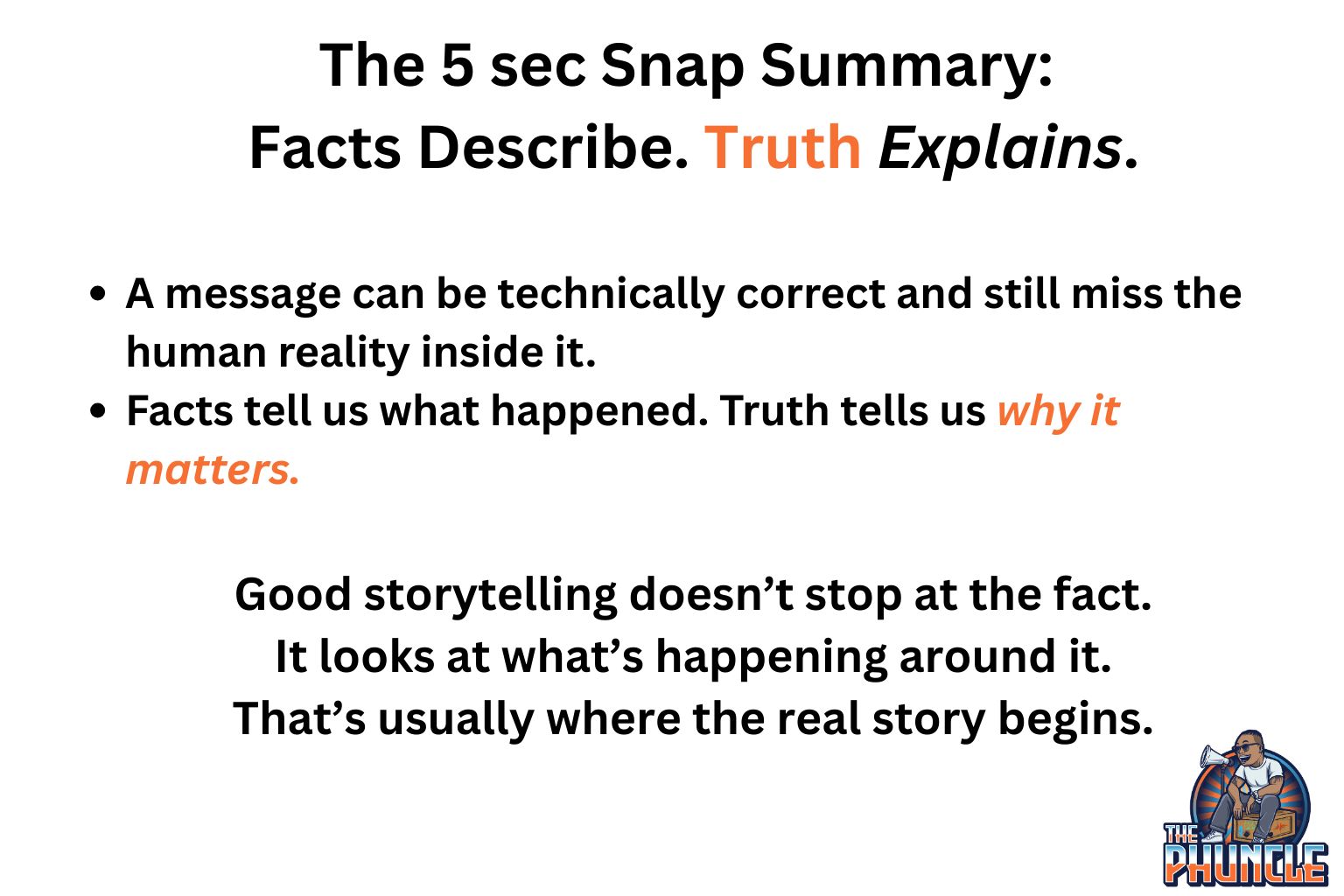
Facts tell us what happened.
Truth tells us what moments mean.
You can have one without the other.
And this difference shows up quite often in health conversations.
It’s currently National Nutrition Month. Let’s look at how something might show up in this realm.
“Breakfast improves academic performance.”
Okay.
That may be factually supported.
But the truth might sound more like:
Some kids are sitting in math class, wondering when they’ll eat next.
Facts, though important, often don’t go deeply enough.
Truth tells us where the pressure is, and storytelling lives in that pressure.
Because if you only give people the facts, you might inform them.
But when you reveal the truth inside the moment? It’s more emotionally gripping.
And that’s where storytelling actually begins.
Instead of simply recounting events and summarizing, stories engage with harder questions.
Stories don't stop at "what happened?"
Stories ask: "What did this moment reveal?"
About a person.
About a system.
About an experience.
Take a familiar recommendation:
“People should eat more fruits and vegetables.”
Fact.
But storytelling asks something different.
What happens between the recommendation and the plate? Between the grocery store and the kitchen?
What happens between knowing something and being able to act on it?
That’s where truth starts showing up. And truth doesn’t cancel the fact.
It adds the missing dimension.
That’s where storytellers do their work. Not by changing the fact but by asking one more question.
When you hear a fact, ask:
“What’s happening around this fact?”
What pressures are touching it? What tradeoffs surround it?
Sometimes the answer is structural, or cultural, or deeply personal.
But once you start asking that question, you get an opportunity to turn a fact into a story.
🧠 Story Science Side Note: Research in cognitive psychology shows that information becomes easier to recall when it is tied to meaningful context rather than presented as isolated facts.
https://link.springer.com/article/10.3758/s13423-020-01853-1
📝 Message Makeover:
Before
“Share the facts.”
After
“Show people what the facts mean in real life.”
The difference between fact and truth.
🛠️ The PHacilitator’s Corner:
Take any health fact you hear or see.
Then ask yourself two questions:
1. What’s the fact?
2. What truth might be sitting underneath it?
Reveal the human reality around it.
That’s usually where the story lives.
Keep spinning dem yarns y’all.
Bye for now!