- The Productive Disruptive
- Posts
- Stories can heal(and haunt)
Stories can heal(and haunt)
Every Tuesday, The Productive Disruptive delivers storytelling science, message makeovers, cultural commentary, and a little rebellious hope for anyone still stubborn enough to believe communication can change the world.

Dorian Johnson
November 18, 2025
Did a wise PHriend forward this to you? [Subscribe here.]
Humans love to think they’re logical.
Rational.
Facts-first.
But the truth?
Our brains are full-time film directors who will throw logic off the set if a story walks in with better lighting.
That’s the paradox of human communication:
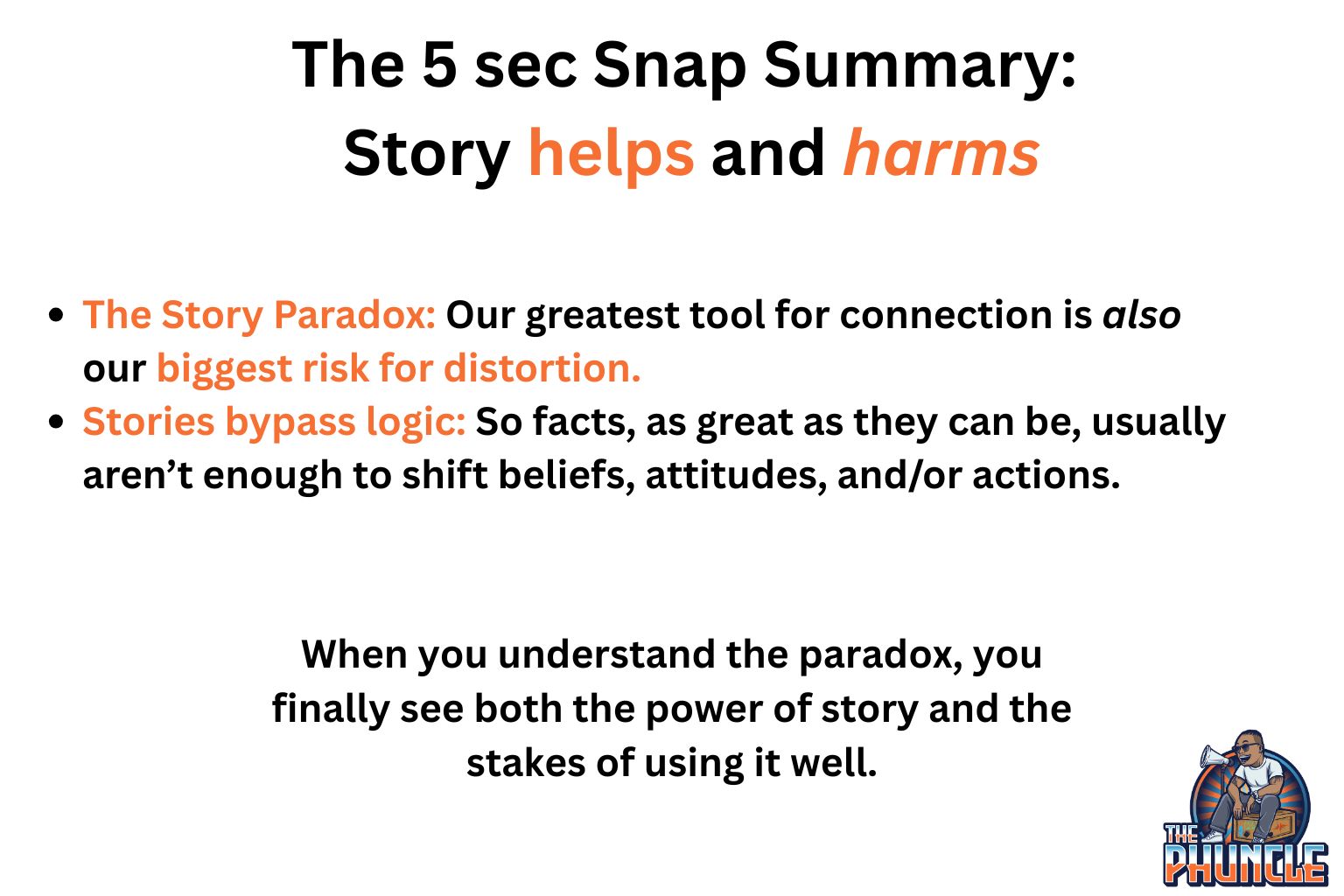
Stories heal… and haunt.
They’re the reason communities connect and the reason communities combust.
That’s the energy Jonathan Gottschall brings in The Story Paradox, and let me tell you: once you see what he’s pointing at, you cannot unsee it.
And the wildest part?
We use it constantly without even knowing we’re doing it.
Everything good about storytelling is everything dangerous about it.
Stories simplify → which helps us learn.
Stories simplify → which helps misinformation spread if people kinda get the gist and miss nuance.
Stories create empathy → which connects us.
Stories create villains → which can divide us.
It really is “heal and haunt.”
We’re carrying a tool capable of both medicine and mayhem, depending on how we use it.
Humans communicate to influence.
And story is the cheat code.
When you hear a compelling story, your brain is basically like:
“Oh, we’re in the story? Bet. Let me rearrange your whole internal world to match.”
There’s a term for it, narrative transport.
It’s this in action.
This is great when the story is true and humanizing.
This is a disaster when the story is oversimplified, weaponized, or straight-up wrong.
Story Paradox.
🧠 Story Science Side Note: Narrative transport is the psychological state where a good story “pulls you in” so deeply that your emotions, beliefs, and even bodily responses start syncing with it.
Once you’re transported, it’s like logic isn’t driving, it’s in the passenger seat holding snacks and shouting directions.
That’s why stories change minds faster than facts.
It’s also why stories can quietly rewrite beliefs you didn’t know were being edited.
I highkey may have already used narrative transport, I dead cannot remember but the shoe fits here, so another application or hey, the term for the first time.
That’s where it gets a lil dicey.
Every harmful social narrative starts with someone believing they’re the hero fighting a villain.
We’ve seen this in public health, politics, education, race, gender, everywhere.
📝 Message Makeover:
Narrative Persuasion works to shift beliefs or actions of listeners/readers/viewers.
I like “story sway”
If story works to inform, how might what you say, sway?
It has the power to, so be intentional.
🛠️ The PHacilitator’s Corner:
When a story chooses the wrong villain, people get hurt.
Most public narratives villainize people
Shift the villain from people → to the forces shaping their choices.
For example…
Instead of:
“Communities don’t prioritize health.”(ever hear this one? 🙄)
Try:
“Communities are working to build health inside systems that have historically under-resourced them.”
This one shift does so much at once:
It creates compassion.
It corrects the narrative.
It shares the community as playing active roles, not passive ones.
It opens the door to solutions.
And most importantly, it leads to stories that heal rather than haunt.
Write a 3-sentence story using the Villain Shift.
What do you notice? You might be shocked at how fast the whole story could transform.
Bye for now