- The Productive Disruptive
- Posts
- Shakespeare Got You Shooketh
Shakespeare Got You Shooketh
Every Tuesday, The Productive Disruptive delivers storytelling science, message makeovers, cultural commentary, and a little rebellious hope for anyone still stubborn enough to believe communication can change the world.

Dorian Johnson
October 07, 2025
Did a wise PHriend forward this to you? [Subscribe here.]
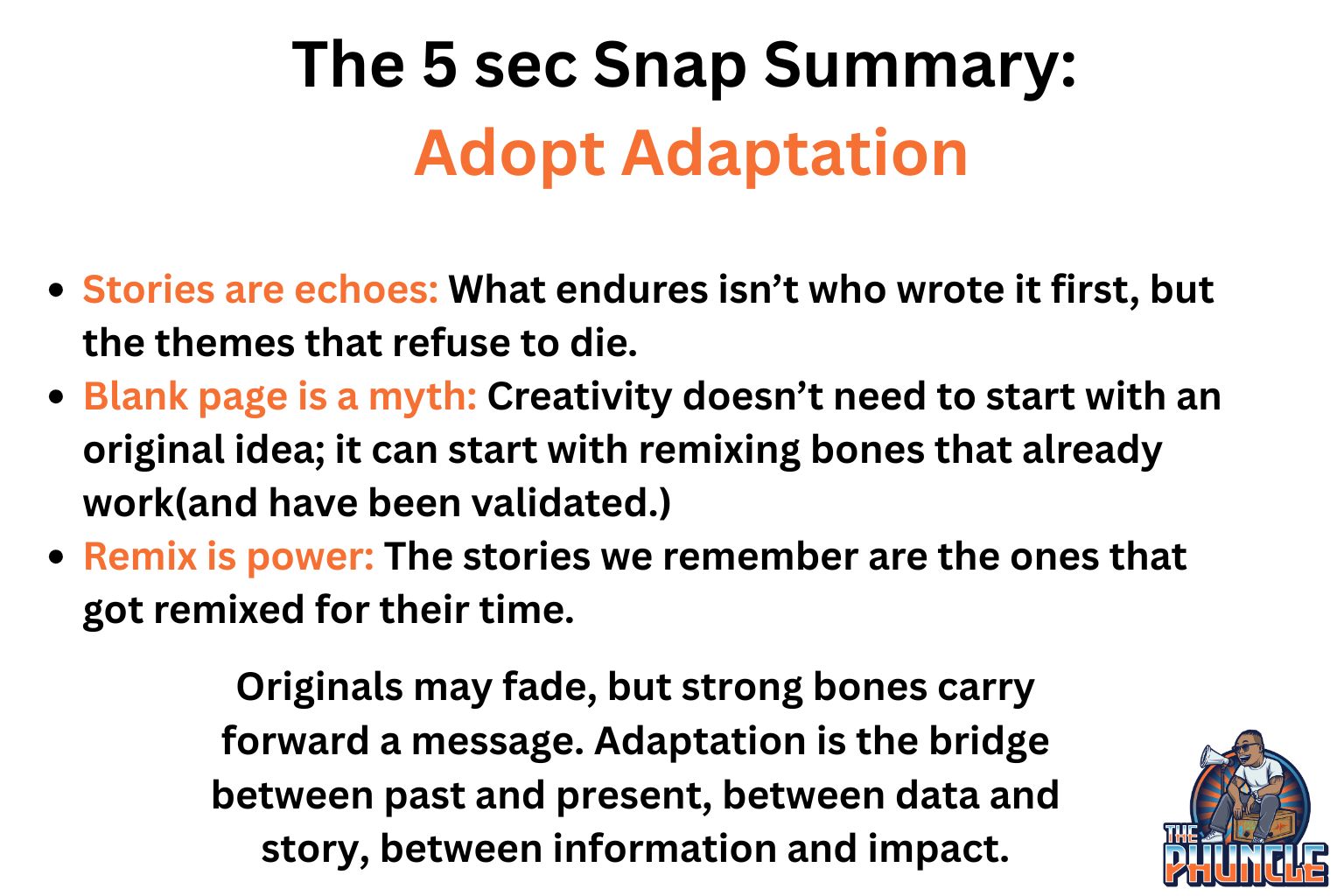
A story endures.
Not because the author lived forever,
but because the themes refuse to die.
We remember Shakespeare
because his writing stuck.
Centuries later, the same themes resurface in new clothes:
Ambition. Betrayal. Power. Family.
Shakespeare’s bag was comedies and tragedies. We’re a long way from the 1500s but he hath been GOATED.
Pop quiz: which of these classics was Shakespeare’s original?
Hamlet
Romeo & Juliet
Can you believe neither of them is?
Each one was a remix of an older tale:
Hamlet → Scandinavian legend of Amleth
Romeo & Juliet → Italian novellas 60 years before Shakespeare, according to Verona tour guides.
Remixing Didn’t Stop with Shakespeare
You’ve seen this same move play out everywhere.
Remember sitcoms? (Damn, I miss those.)
One of the most recycled plots went like this:
Something wild happens.
Character A tells the story one way.
Character B tells the story the exact opposite way.
Then a neutral character pops up from somewhere and sets the record straight.
That’s it.
That’s the whole plot.
Different shows. Different decades.
But the bones stayed the same because they worked.
It wasn’t about who invented the story.
It was about who adapted it well enough to land with that audience.
🧠 Story Science Side Note: Constructivism shares that people don’t learn by starting from scratch, they build new meaning on top of what they already know.
That’s why Shakespeare’s adaptations stuck.
That’s why music samples feel so good, half the joy is recognizing the echo of the original.
We’re remix machines..
📝 Message Makeover: Original? Could feel pressure to create something never seen before.
Maybe it’s an echo instead.
Now, Shakespeare?
Didn’t seem like he cited his sources (rude).
But you know better.
You’ve got dissertations, citations, and a whole Zotero folder to prove it.
Your original research topic probably came from checking the literature.
Very similar energy in storytelling.
How is your echo inspired by the original? Make your version one that sticks.
You don’t need to start with a blank page to make something powerful.
Shakespeare didn’t. Sitcoms didn’t. Music producers don’t.
Spotting the bones that endure, and then adding your voice, your flavor, your context, can create your next great story.
That lowers the barrier to entry.
It frees you from “I have to invent something original.”
🛠️ The PHacilitator’s Corner:
Let’s borrow that classic sitcom plot:
Character A says one version.
Character B says the opposite.
Character C shows up with the fuller truth.
Now remix it for public health. Here’s one example with prevention:
A: “An ounce of prevention is worth a pound of cure.”
B: “Prevention doesn’t work; people don’t listen.”
C: “Prevention works best when it’s designed with people’s realities in mind, not just dropped on top of them.”
Your turn:
Take a theme you care about — mental health, nutrition, equity, vaccines — and write a 3-line mini-scene.
A oversimplifies.
B contradicts.
C reframes with context.
With chaos and confusion,
I mean, calm and clarity ✌🏾