- The Productive Disruptive
- Posts
- Meet me in the middle (of the story)
Meet me in the middle (of the story)
Every Tuesday, The Productive Disruptive delivers storytelling science, message makeovers, cultural commentary, and a little rebellious hope for anyone still stubborn enough to believe communication can change the world.

Dorian Johnson
October 21, 2025
Did a wise PHriend forward this to you? [Subscribe here.]
For too many storytellers, the setup actually kills the story.
Not because the setup’s wrong, but because it’s safe.
Safe don’t necessarily connect…
You’ve probably seen it before:
“I got into this field because I’ve always been passionate about…”
“I started my journey back in 2019…”
Cute. Chronological. Ol’ reliable.
But that could be a missed opportunity.
Because connection doesn’t live in your timeline of the tale.
It lives in your turning point.
That’s the middle.
That’s the moment everything shifted.
When things took a sharp turn left, then right, but ultimately, got a satisfying resolve.
I remember being a kid, maybe 6 or 7, complaining about something that “wasn’t fair.”
My dad didn’t skip a beat.
He looked up and said, “Who told you life is fair?”
I could open a story right there.
I didn’t get it at the time, but that was an instant worldview shift.
“Who told you life is fair?” my dad said, not even looking up.
That’s when it hit me inequality wasn’t an idea I’d study one day. It was already studying me…
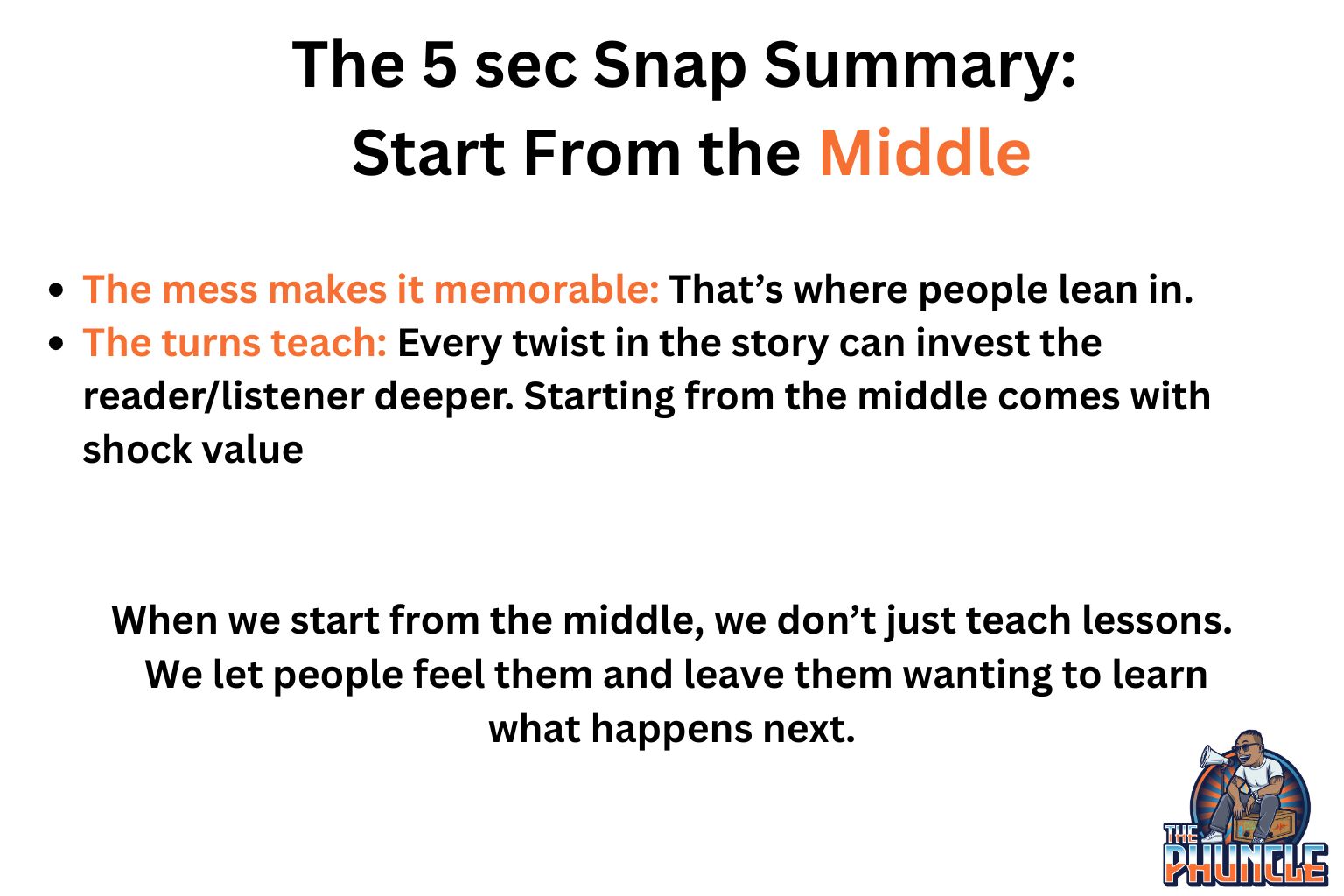
Starting from the middle can be an unexpected shock.
You start where the lesson is born, not where it’s neatly wrapped.
We’ve been conditioned to start from context because it feels professional. Polished.
But connection? That’s raw. It’s messy. It’s mid-sentence, mid-tear, mid-revelation.
It’s not the “I launched my campaign” part.
It’s the “If our smoking session campaign flops one more time, I’m losing it…” part.
Did you get pulled in?
Curious about the previous failed attempts? Wonder if the next campaign succeeds?
If so, congrats! You just got Zeigarnik’d.
🧠 Story Science Side Note:
Ever notice how an unfinished story sticks in your head longer than one that tied up too neatly?
That’s the Zeigarnik Effect in action; the brain’s habit of replaying what isn’t done yet.
When you start your story in the middle… mid-conflict, mid-question, mid-“wait, what?” you’re tapping that same tension loop.
Your reader’s brain wants closure, so it hangs on every word until it gets it.
It’s worth considering adding starting from the middle to your toolbox.
📝 Message Makeover:
Old: “I want to give a little context first.”
New: “Let me tell you what almost made me walk away.”
That’s the shift from informative to immersive.
From story as setup to story as spark.
When you start with the middle, your audience doesn’t need context to care.
They care because you made them feel before they could analyze.
🛠️ The PHacilitator’s Corner:
This week, try this:
1️⃣ Think of a story you’ve told before, one that starts too neatly.
2️⃣ Find the exact moment tension entered the picture.
3️⃣ Rewrite your opening to start there.
I am a huge believer that even the driest stories could drip with sauce.
You might just starting in the wrong place.
The beginning explains.
The middle reveals.
And revelation is what keeps people coming back.
Consider the middle