- The Productive Disruptive
- Posts
- Don’t Dump, Zoom
Don’t Dump, Zoom
Every Tuesday, The Productive Disruptive delivers storytelling science, message makeovers, cultural commentary, and a little rebellious hope for anyone still stubborn enough to believe communication can change the world.

Dorian Johnson
December 30, 2025
Did a wise PHriend forward this to you? [Subscribe here.]
If someone has ever told you,
“Can you make this shorter?”
They were probably not saying:
You need to be less accurate(could you imagine)?
They were likely saying something like.
“There’s too much here for me to get it.”
Now, it becomes a focus issue.
And if you work in public health, education, research, or academia-adjacent spaces…
you’ve been probably doing the opposite.
Maybe you were taught to:
Define everything
Contextualize everything
Anticipate every critique
Explain the system and the exception and the exception to the exception
So when you tell a story, you don’t just tell a story.
You build a buffet.
And then wonder why people walk away stuffed but unsatisfied.
Here’s the reframe that can help.
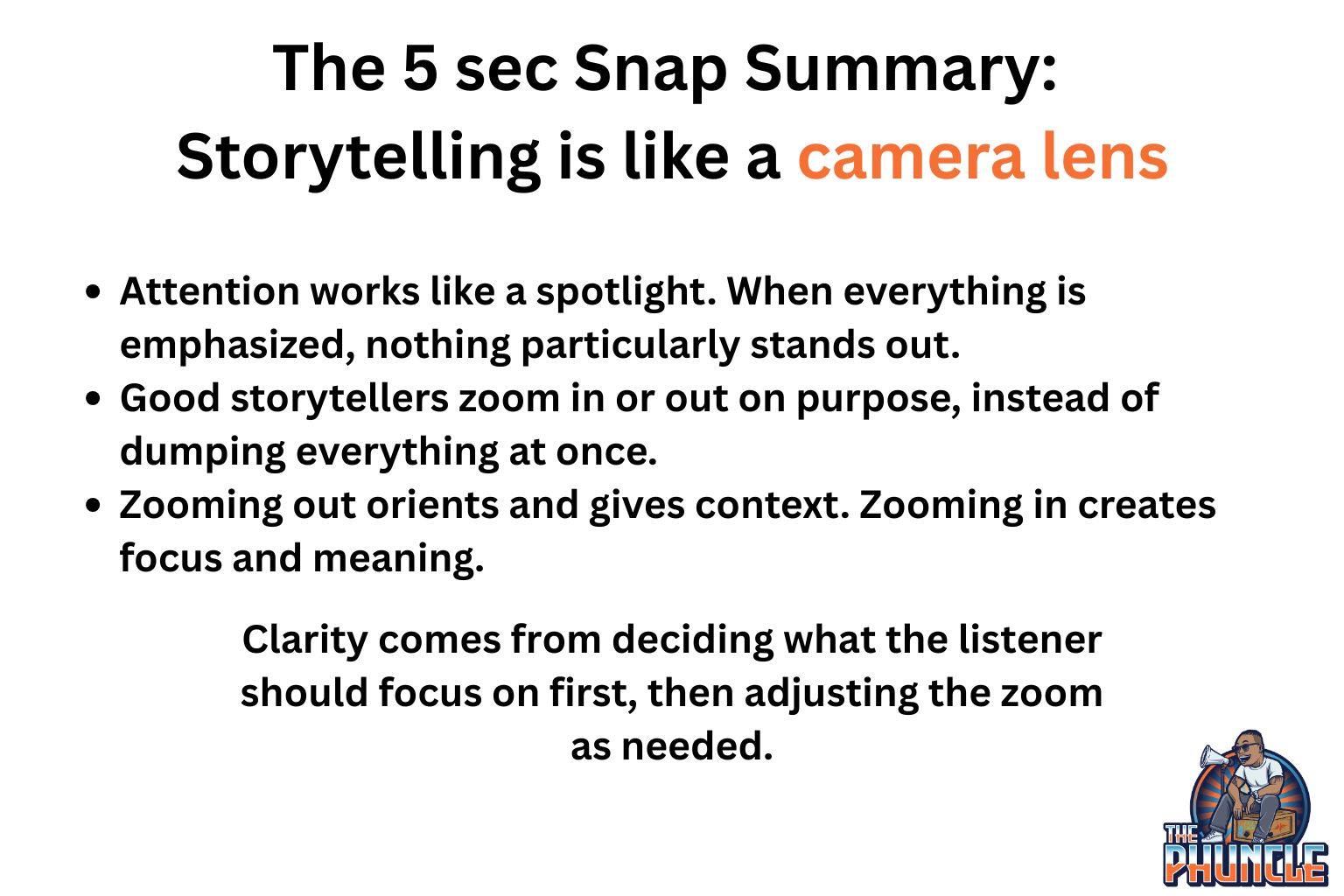
A story is like a camera.
You don’t make a scene clearer by adding more stuff to the frame.
You make it clearer by deciding how far in or out to zoom.
Same scene.
Same truth.
Different distance.
When you zoom out, you help people orient.
They see the system. The pattern. The big picture.
When you zoom in, you help people feel.
They see the moment. The consequence. The human cost.
Stories often fall apart when we try to do both at the same time.
We zoom out, then zoom in, then zoom out again.
Mid-sentence.
Mid-thought.
Mid-breath.
It’s like trying to watch a movie where the camera operator is buzzzzzzing after downing an energy drink.
That shot just ain’t gon hold.
This is pretty much overexplaining, and to the listener of a story, it tends to crowd things…
The brain can only process so much at once before diminishing returns kick in.
When you overload working memory with background info, caveats, and definitions all at once, comprehension drops.
Brains have a bandwidth.
When everything is emphasized, nothing is.
When everything matters, nothing sticks.
The Camera Lens rule helps you be more selective and effective.
🧠 Story Science Side Note:
Think of attention like a spotlight.
It’s great at lighting up one thing.
It’s bad at lighting up everything.
When a story tries to emphasize too many parts at once, attention jumps instead of focuses.
📝 Message Makeover:
From: “Be more concise”
To: Zoom with intention
Concise is about cutting length.
Zoom is about choosing focus.
You don’t shrink the story.
You decide what the listener should see right now.
🛠️ The PHacilitator’s Corner:
Pick one story you tell often.
A concept you explain at work.
A story you feel tempted to over-explain “just in case.”
Before you tell it again, do this two-step calibration.
Step 1: Decide your starting zoom
Ask yourself:
Do they need orientation first?
Or are they ready for impact?
This matters because attention needs somewhere to land before it can move.
Step 2: Expand or contract intentionally
As you tell the story, notice the moment when:
faces change
questions surface
energy shifts
That’s your cue to adjust the zoom.
You’re playing the story to the room.
The rule to remember:
Change the zoom between moments, not mid-thought.
Let one focus land.
Then expand or contract as needed.
Afterward, reflect:
Last issue of 2025, my 30th one.
See you next year!