- The Productive Disruptive
- Posts
- Creativity Loves a Cage?
Creativity Loves a Cage?
Every Tuesday, The Productive Disruptive delivers storytelling science, message makeovers, cultural commentary, and a little rebellious hope for anyone still stubborn enough to believe communication can change the world.

Dorian Johnson
December 09, 2025
Did a wise PHriend forward this to you? [Subscribe here.]

I want to let you in on a secret…
When my brain hears “just write a story.”
It does a couple things… A couple, loud things.
For example.
I suddenly flash back to that old school dial-up internet screech
EeeeeOOOOWWRRHHHKKKKK–SHHHHHH–krrrrrrr…

“Get off the internet, I’m on the phone,” screeches in my head.
That’s what “total creative freedom” feels like to me.
Chaotic. Loud. Overwhelming.
But give me a prompt?
A small container that my words can move within?
A tiny boundary to play inside?
Suddenly, I’m a laughable laureate.
And this all clicked for me today when I saw my copy of the game Ransom Notes.
If you’ve never played it, it’s a lot, but it teaches this lesson very well.
Not only do you get a prompt, but you also get a handful of random words and have to piecemeal a sentence(or at least a coherent thought) to satisfy that prompt.
That boundary, paradoxically, creates freedom in storytelling.
The smaller the space, the easier creativity flows.
It sounds backwards.
It is backwards.
Too much space? Overwhelm. That’s hearing “Just write a story”
But a little structure? Your writing or stories are more likely to have some movement.
That’s actually why prompts work so well.
They give your mind something to grab onto, a starting point, an anchor, a spark.
Otherwise, your brain starts to drown in infinity.
It’ll scream to “get off the internet” because it’s trying to use the phone.
All your brain wants is a solid footing to get moving. Thankfully, prompts are the scaffolding that make it possible.
🧠 Story Science Side Note: Scaffolding is a term used in instructional design and curriculum writing where teacher, sensei, whomever, slowly removes guidance and support as the learner builds skill and competence.
Prompts act as a a scaffold for your storytelling(and ain’t no shame in using them).
Prompts help you start.
Then they let you surprise yourself.
And what I love most is how they pull out memories you didn’t even know were waiting in the wings.
Here’s the gentle part I want to offer you:
You don’t have to force a story into existence.
Try giving yourself boundaries and see what shifts.
📝 Message Makeover:
Before: “I have writer’s block.”
After: “I just need a boundary to begin.”
It reframes writer’s block from a defect to a design issue.
Why not normalize structure and give yourself some relief?
🛠️ The PHacilitator’s Corner:
If you really want to feel how boundaries create flow, try this tiny experiment today.
Pick one constraint below and write a micro-story in 60–90 seconds. No editing. No polishing. No perfectionism.
Just movement.
Tell a story using five words only.
Write about a bad day, but as a text message to a friend.
Rewrite a memory from a different perspective.
Write a story where the object nearest to you becomes a character.
Boundaries shrink the universe so your brain can actually start moving.
You’re not “forcing creativity,” you’re giving it a place to land.
The goal is to feel how your mind adapts once you take infinity off the table.
One tiny(or big) constraint can fuel your next story.
You might’ve just needed a place to begin.
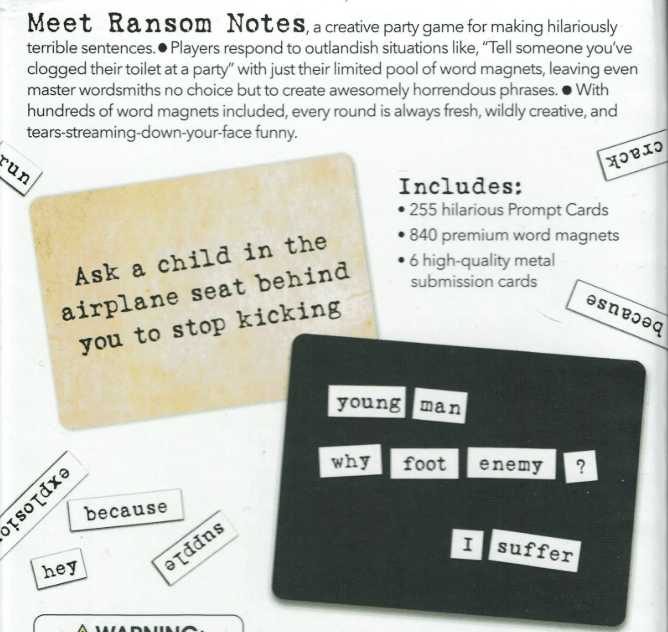
The back of Ransom Notes. Thankfully, they had good word magnets.
How’d I do?
/