- The Productive Disruptive
- Posts
- Back then they didn’t want me, now I’m hot they all on me
Back then they didn’t want me, now I’m hot they all on me
Every Tuesday, The Productive Disruptive delivers storytelling science, message makeovers, cultural commentary, and a little rebellious hope for anyone still stubborn enough to believe communication can change the world.

Dorian Johnson
August 12, 2025
Did a wise PHriend forward this to you? [Subscribe here.]
Public Health has an open secret…
We’re victims of our own success.
When it’s working, the people who need to see it most… don’t.
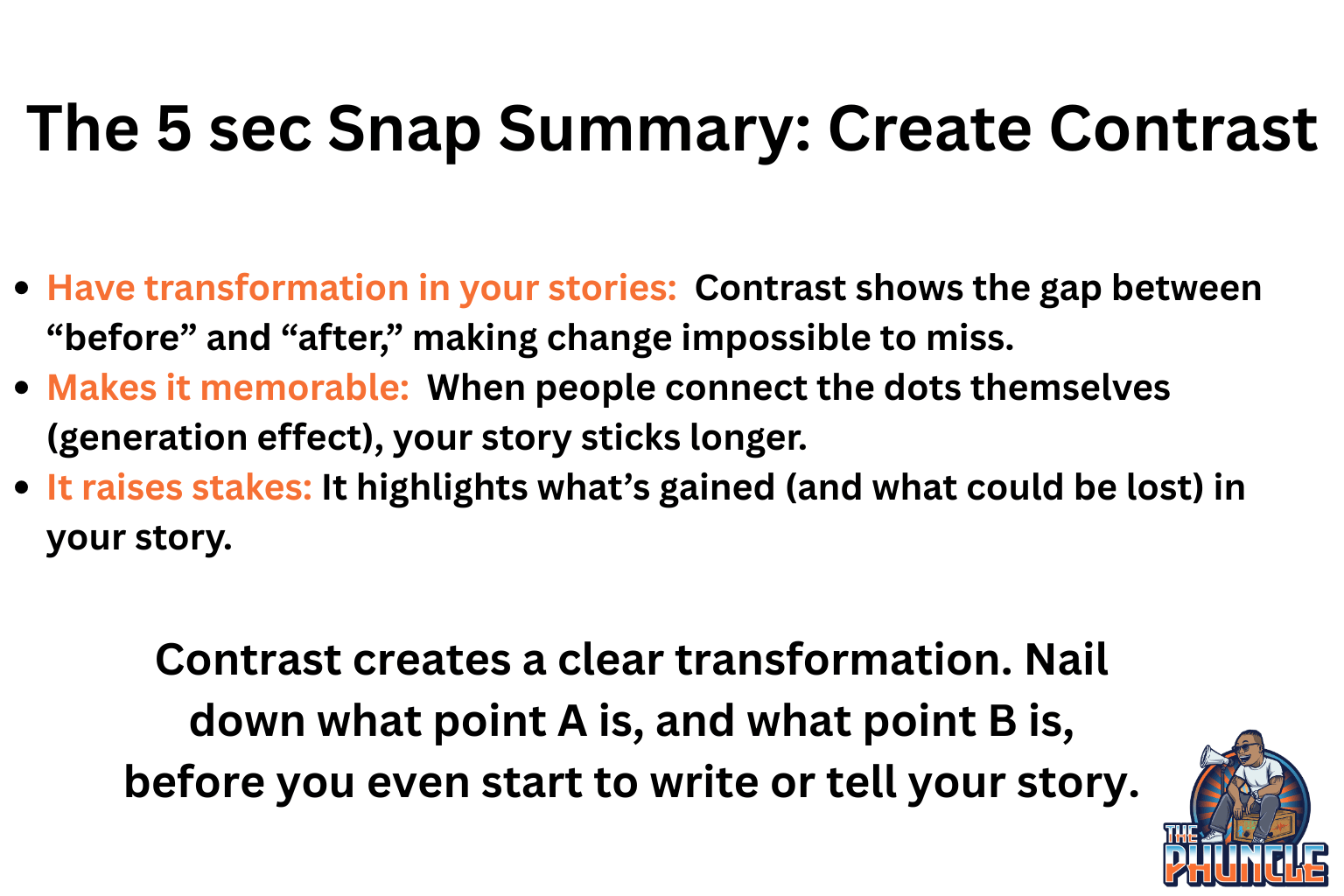
That’s why one of our sharpest storytelling tools is contrast.
Contrast has the power to show people where things started vs. where they are. Using contrast:
Raises the stakes, and
Makes your story harder to ignore

Zoinks! Like Scoob, what happened at Grandma’s House?
Why Contrast Hits Different
Contrast honors the struggles, the wins, and the sacrifices that got us here, and also reminds people what’s on the line if we lose it.
In this case, a public health story can be made stickier by carrying the torch from the past to the present, all while keeping the work alive in people’s minds.
Quick example.
Think about one of the most unpopular yet overlooked public health lesson.
Did you think of clean water? (Boy, I hope so.)
Water isn’t the sexiest of topics, especially in countries where it’s easy to take for granted.
I made a TikTok. About water.
Over 260K views later, here’s what I learned. It was the Contrast Gap.

Something had to change for that to happen. That’s the teachable moment.
That’s where you slip in the story.
And yes, that’s the invisible muscle of public health: sanitation, infrastructure, and decades of policy.
🧠 Story Science Side Note x Message Makeover: Abstract says “The generation effect is a robust memory phenomenon in which actively producing material during encoding acts to improve later memory performance”
How might this be made over?
The effect tells us people remember more when they fill in the blanks themselves. If you can get someone to do a little mental lifting, they’ll remember your message longer.
A strong “before” makes them curious about the “after.”
A strong “after” makes them reimagine the “before.”
When the stakes are this high, you want the ending they land on to be the one that fuels action.
You’ve likely seen this in other ways, too.
A popular meme format is
“How it started” vs “How it’s going” or “Expectation” vs “Reality”
These are both the contrast gap in practice.
And boy do they stick.
So use it however you’re comfortable.
🛠️ The PHacilitator’s Corner:
Tell a story in 3 sentences using one of these contrast formulas:
Then / Now
Status Quo / Ideal Outcome
Then/Now Example:
“Back then, drinking water could give you a parasite and maybe even kill you. Now, you can drink straight from the tap. You have public health to thank for that.”
Of course, you can flesh it out later, but isn’t it powerful to know a story can be as short as three sentences?
Wrap up
Rumor has it Ernest Hemingway once told a complete story in just six words:
For sale: baby shoes, never worn.
It’s been discredited how it wasn’t a Hemingway original, though. It came before his time.
But note the contrast! 3 sentences may have felt a lil daunting, but compared to six words, it might feel even easier, especially with a formula.
PS: By the end of this month (and yes, I know I need to get on it, ya boy gets distracted😂),I’ll be dropping The Villain Vault: 10 Story Villains to Unlock Plot to help you spark fresh storytelling ideas.
Because remember: all stories need a villain.
It’ll be free, but the only way to get it is to refer a friend to The Productive Disruptive.
Start thinking of someone now, the referral link will be inside Beehiiv when it drops.
Yabba Dabba Do
I mean, bye for now.