- The Productive Disruptive
- Posts
- A topic is not a story
A topic is not a story
Every Tuesday, The Productive Disruptive delivers storytelling science, message makeovers, cultural commentary, and a little rebellious hope for anyone still stubborn enough to believe communication can change the world.

Dorian Johnson
March 24, 2026
Did a wise PHriend forward this to you? [Subscribe here.]
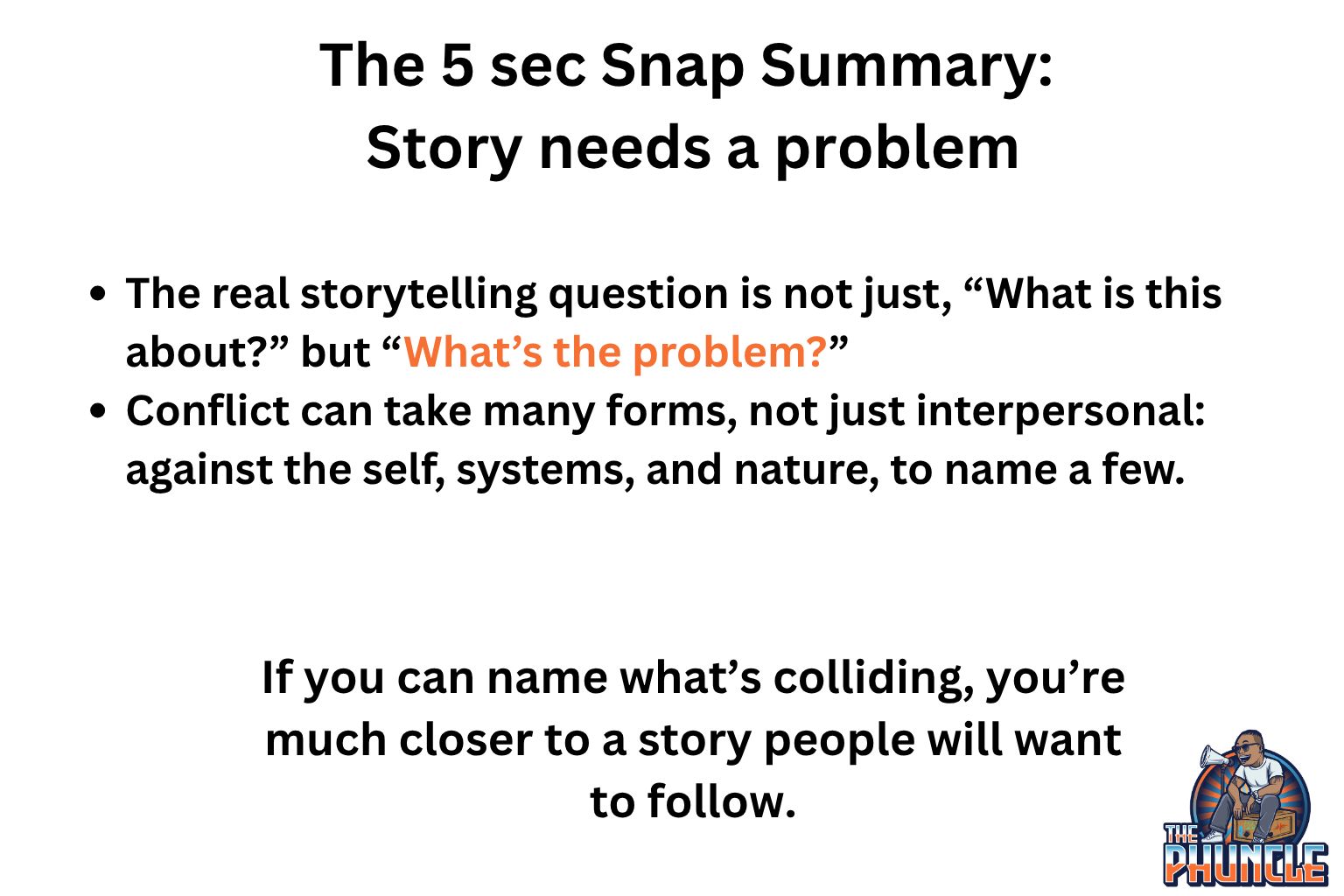
Without conflict, you got nothin.
Well, not nothin’.
You might have a topic.
A premise.
A situation.
But story? Story needs a problem.
Now, when people hear “conflict,” I think sometimes they immediately picture two people arguing in line at Marshall’s or something.
“Excuse me, I was here.”
“No, you weren’t.”
“Yes, I was.”
“Now, why would I lie about something this small?”
I mean, that is a story.
Characters, conflict, setting.
The issue is that many people’s minds stop there.
They think conflict has to be interpersonal. Somebody versus somebody else.
But conflict is bigger than that, and has many faces.
It can be person versus person, yes.
But it can also be person versus self, person versus system, person versus nature, and more.
So don’t limit it to just person v person.
Without conflict, you just have a situation.
Once you start looking for conflict, you realize how many “stories” just don’t cut the mustard.
They might look like one.
They might sound like one.
But a house is not a home.
As Luther said
“A chair is still a chair, even when there’s no one sitting there.”
And a topic is still a topic, even when you keep calling it a story.
A topic tells us what we’re talking about.
Conflict tells us what’s making it hard.
What’s being resisted.
What’s at stake.
That’s the tiny shift I want to hand you this week:
When you think you have a story, ask if you can finish this sentence:
The real conflict here is…
That one move will force the story to show its hand.
Because the real storytelling question is not just, “What is this about?”
It’s, “What is colliding here?”
🧠 Story Science Side Note: Our brains are drawn to tension because tension gives us something to track. Once there’s a problem, obstacle, or unresolved question, we naturally want to know what happens next. That’s part of why conflict matters so much in storytelling. It creates a reason to keep paying attention.
📝 Message Makeover:
Before:
“This story is about community.”
After:
“The real conflict here is people are being asked to build community in conditions that keep people isolated.”
🛠️ The PHacilitator’s Corner:
Apply “The real conflict here is…” to something that you’re working on.
Then name the type of conflict:
person vs. person
person vs. self
person vs. system
person vs. nature
If you can name the pressure, you’re much closer to a story.